With acknowledgement to Derbyshire Miscellany Vol. III No. 8. 1966: Garlic. S. L. "Further Notes on Crich" and Ian Castledine
The Butterley Company owned Hilt's Quarry at Crich, which supplied limestone for the ironworks and for the limekilns at Bullbridge, providing lime for farmers and for the increasing amount of building work. The steep wagonway to the Cromford Canal at Bullbridge was called the Butterley Gangroad and incorporated the world's oldest surviving railway tunnel, at Fritchley (built 1793).
The earliest record of a mineral line in Crich is the old tramway constructed about 1793. This was a subsidiary of the Cromford Canal, the engineers being W. Jessop and J. Outram. The purpose of the tramway was to bring down lime stone excavated at the Old Hilts Quarry to the canal at Bullbridge where the Butterley lime kilns were situated.

The following information was sourced from Wonders of the Peak website.
The operation of the limeworks, the gangroad and the quarry at Crich was subcontracted from in the early years from 1793. In 1796-7 a house was built at the Amber Wharf for the use of the manager of the works. In 1805 the quarry, kilns and the railway were leased to Edward Banks & Co. for a period of 14 years. Initially there were three kilns at the Amber Wharf which was located on the curve of the canal at Bullbridge. In later years additional kilns were added and in the 1890s the limeworks, including the kilns, were expanded. Limestone transported on the gangroad from the Warner quarry at Crich was either burnt in the kilns at Bullbridge or loaded onto canal barges for onward transportation on the the canal to the Butterley works at Ripley.

Amber Wharf plan 1805

Amber Wharf plan 1880

derelict lime kilnes
photo David Kitching: Derbyhire lime kilns

Derbyshire Historic Environment Record
Monument record MDR4975 - Lime works (site/remains of), Bullbridge, Ripley
Sources/Archives (7)
- <1> SDR10751 Bibliographic reference: Nixon, F. 1969. The Industrial Archaeology of Derbyshire. p 232.
- <2> SDR18863 Article in serial: Foden, D B & Stead, L J. 1965. 'The Archaeology of Industry in Derbyshire - Bull Bridge', Derbyshire Miscellany. Vol 3, Part 5. p 1.
- <3> SDR18315 Bibliographic reference: Fowkes, D (ed.). 1993. Derbyshire Industrial Archaeology: A Gazeteer of Sites Part III: Borough of Amber Valley. p 25.
- <4> SDR18789 Map: Ordnance Survey (OS). 1882. OS County Series, 1st edition, scale 1:2500 (c. 25" to one mile). Sheet XL.1, 1880.
- <5> SDR18790 Map: Ordnance Survey (OS). 1896-1900. OS County Series, 2nd edition (1st revision), scale 1:2500 (c. 25" to one mile). Sheet XL.1, 1900.
- <6> SDR18867 Map: Ordnance Survey (OS). 1937-38. OS County Series, Third Revision, scale 1:2500 (c. 25" to one mile). Sheet XL.1, 1937.
- <7> SDR4874 Unpublished document: Desc Text: MPP Step 3 Report: Trueman 1997. No. 23.
Some contradictory reports are riven of the various forms of transport used by the Butterley Company on this tramway, but-it is fairly certain that at first horses drawing five trams in both directions were the only transport. There was a self-acting incline from the Wharf and Lime Kilns at Bullbridge, horses being retained for use inside the quarry at Crich.
In 1812, William Brunton, an engineer for the company, produced his remarkable Steam Horse locomotive. Then in 1813 this walking steam locomotives, constructed at Butterley Ironworks, was tried out on this tramway.
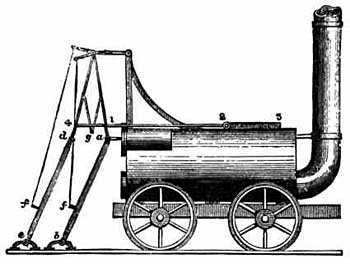
Brunton's walking steam engine

Fitz was one of the later, more traditional, steam engines used on the tramway.
It was named after Fitzherbert Wright, the Managing Director of the Butterley Company.
Photographs courtesy Ian Castledine

Remains of tramway over Gas Lane/Drovers Way

Lime kilns at Bullbridge
At the Easter Session 1827 the Butterley Company obtained a licence for a Powder Magazine at Amber Wharf near Bull Bridge in the parish of Crich
Bullbridge Aqueduct & Lime Kilns (source Friends of Cromford Canal)
At the north end of Bullbridge Aqueduct were the Butterley Company’s lime kilns and limestone loading wharf, built at the same time as the canal. Limestone was brought down the ‘Butterley Gangroad’ (a tramway) from Crich to the wharf where some was burnt and some was loaded straight onto boats for transport to the Butterley Co’s works above Butterley Tunnel.
The aqueduct, or extended embankment, crossed the Amber Valley and included openings for a minor road (today, Drovers Way), the River Amber, and the turnpike road (today the A610). Built for stagecoaches and carts, the arch allowing the turnpike road to pass did not suit modern transport requirements but it lasted until 1968 before it was demolished, sadly now leaving a ‘gap’ in the embankment.
When George Stephenson was building his North Midland Railway from Derby to Leeds, it had to pass under the canal here at Bullbridge. As the canal was there ‘first’, the Cromford Canal Company could dictate the terms for the construction of the railway, and stipulated that canal traffic should not be delayed. The railway company had Butterley iron works produce a cast iron tank 150ft long, 9ft wide and 6ft deep.
It was conveyed to Bullbridge, presumably floating in the canal, in five parts and, starting at midnight on Saturday 2 March 1839, the parts were assembled, floated into position and sunk into place within twenty-four hours.
Traffic on the canal was not disrupted as it was normally closed on Sundays. The bridge for the railway was subsequently dug out beneath the trough.
This aqueduct was demolished at the same time as the road aqueduct.
History, Gazetteer, and Directory of the County of Derby 1857
The Butterley Iron Company have also extensive lime works at Bull Bridge where abouts 8,000 tons of lime and 30,000 tone of stone are sold yearly. About 50 men are employed at these works. Mr Peter William Bowne is the resident manager. Messrs Curtis and Harvey's gunpowder magazine is also situated at Bull Bridge.
Butterley Lime Works closed in 1933
Kelly's Directory 1891: Bullbridge
COMMERCIAL.
Ambergate, Crich, Bull Bridge & Fritchley Gas Go. Lim. (John Dawes, sec. ; John Bown, manager) ; works, Bull bridge
Butterley Company's Quarries & Lime Works (Jn. Hy. Day agent), Bull bridge
Curtis & Harvey's Gunpowder Magazine, (John Henry Day, agent), Bull bridge
Bulmers 1895 Directory: Bullbridge
Butterley Co., Ltd., lime merchants; John P Hamilton, resident manager