The influence of William de Wakebridge on Crich Church was recorded by A.B. Done in his 1912 book "History of St Mary's Church, Crich".
The family of De Wakebridge were always closely associated with Crich. During the reign of King John a marriage took place between Peter de Wakebridge and Emma, sister of the then Lord of Crich. Their great grandson, as a knight of the shire, represented the county in several parliaments of Edward III. It is, however, to Sir William de Wakebridge, a son of the latter, that Crich church is most deeply indebted. This redoubtable warrior, with probably some of the inhabitants of Crich, took part in the opening battles of the Hundred Years' War—a war famous for the English victories at Crecy, Poitiers, and many years later at Agincourt. Shortly after his return, the whole country was devastated by that terrible plague known as the “ Black Death.” This awful malady carried off more than half the population of England. Within three months Sir William lost his father, his wife, three brothers, two sisters, and a sister-in-law—how many of Crich’s humbler inhabitants perished during that dreadful year 1349, we shall never know.
Sir William, after this visitation, decided to found a chantry or endowed chapel, in connection with Crich church, in which, besides services appointed for other days, on the feast of St. Katharine (Nov 25th) each year, full service of the dead was to be said, and a distribution of ten shillings made to the poor. This chantry, which was dedicated conjointly to Saints Nicholas, Katharine, Margaret, and Mary Magdalen, was situated at the east end of the north aisle, and the effigy to be found in the niche of that aisle is generally thought to he that of the donor. There is perhaps no one matter in connection with Crich church more discussed than the question with regard to this tomb and effigy. A claim has been made by the representatives of the Rellairs family that the effigy is that of Sir Roger Beler, at that time lord of the manor of Crich, but the evidence available points with utmost absolute certainty to the effigy being that of Sir William de Wakebridge. When the monument was placed in position, two angels were supporting the man’s head, but that on the left is now broken off. The mutilated figure on the right holds a Katharine wheel to the ear of the effigy. It may he remembered that St. Katharine was martyred at Alexandria, in Egypt, in the fourth century, by being bound to a spiked wheel—hence the “Katharine wheel,” with which she is commonly represented. The example of Sir Williams generosity led to further restoration. About that time the church seems to have been much re-built, with the addition ot the chancel, tower, and spire. In 136S Sir William founded a second chantry, probably at the end of the south aisle, where a piscina may still be seen below the south window at the east end of the aisle. A similar piscina, now broken, is also to be found below the south window within the Communion rails. These piscinas were connected with the service of Mass in the Church of Pre-Reformation times. They were small sinks, with a channel leading to the ground on the outside, in a small niche of the wall on the south side of the altar, where the priest poured away the water used for rinsing his hands after the ablutions of the vessels and chalice used in the service of Mass. To each of the chantries Sir William appointed chaplains, so that at that period Crich church was served by a vicar and two chantry chaplains ; while a chantry house for their accommodation was also erected in the town—the site of this chantry house unfortunately cannot be identified.
Photo Peter Patilla
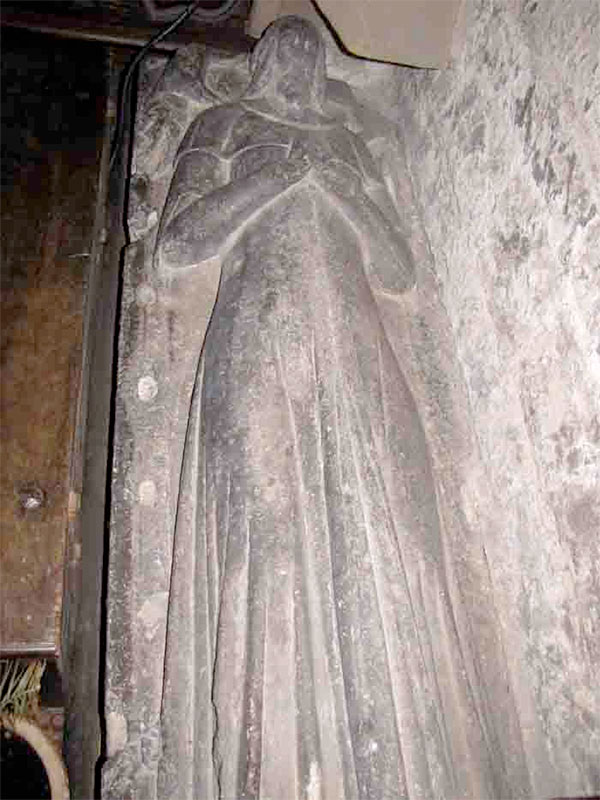
Tomb of William de Wakebridge, St Mary's Church, Crich
More on the de Wakebridge links to St Mary's can be found in Cox's "Churches of Derbyshire" in the Crich chapter