
1786 Enclosre Map for Crich Carr

1849 Crich Carr field names

Detail from Derbyshire surveyed map 1879–1899
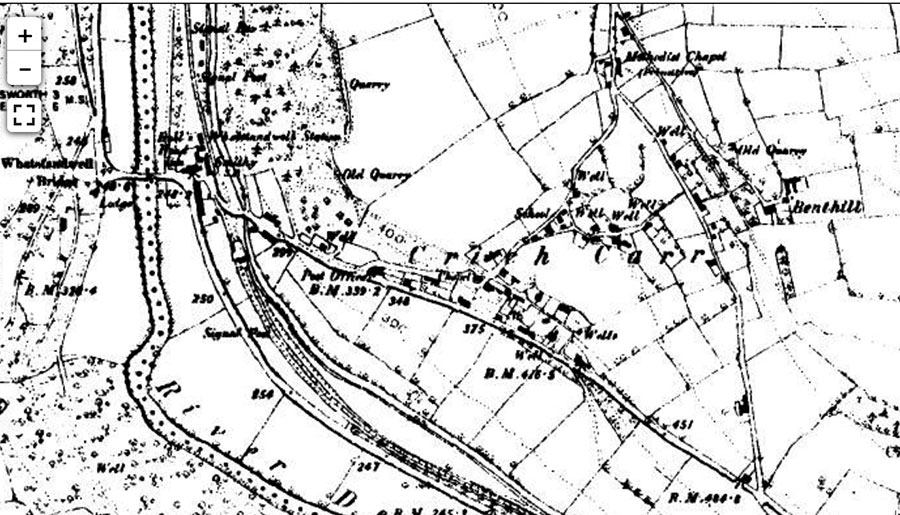
OS Map 034/SE dated 1883–1896
A carr is a waterlogged, wooded area. It derives its name from the Old Norse word "Kjarr" meaning "brushwood".
Historically Crich Carr included most of Whatstandwell and it was only with the coming of the railways after the 1850s that the name "Whatstandwell" gradually subsumed that of Crich Carr. Before the railway Whatstandwell was only the bridge, the Derwent Hotel (previously the Bull's Head", currently "The Family Tree") and the cottage and old smithy building which lie between the river and canal. Whatstandwell was part of Crich Carr, but the Midland Railway named their first station Whatstandwell Bridge and the Ordnance Survey accepted the name. People also used the name and gradually the area of Whatstandwell and Crich Carr became accepted as Whatstandwell.
This history will take a triangular tour from Crich Carr Primary school, up Hindersitch Lane, along Top Lane, down Shaws Hill, along Main Road back down to the school taking in the area contained by this route.
Crich Carr C of E Primary School

The school was built on land donated by The Duke of Devonshire and was opened in October 1884 by Reverend William Acraman, vicar of Crich Parish to which Crich Carr belongs. At this time there was great conflict between the church and the National Schools Educational Boards which were being set up to control the education of children. Acraman was untiring in his determination to maintain church control over the schools in this parish. He was a divisive figure in the community. However, he was successful in keeping Crich Carr C of E Primary, Fritchley C of E Primary and what is now Crich C of E Infant School under church control.
Derbyshire Times 22 December 1833
... Referring to the erection of a new school at Crich Carr the rev. gentleman said the Duke of Devenshire had kindly given them a plot of ground. The building would cost £600 and the furniture for the interior would cost another £100. They looked to the inhabitants to raise that sum. They had already raised £600 (applause)....

Old postcard of the School; note the public water pump by the gate
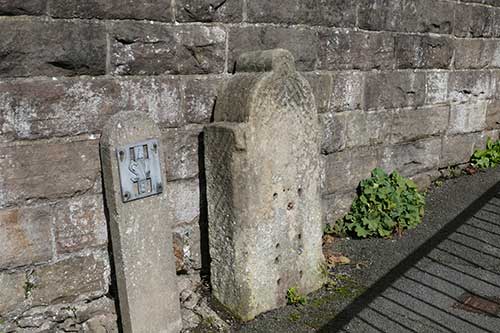
All that remains of the public water pump
Initially the pupil numbers were very low.
Derbyshire Courier 30 August 1884
A correspondent informs me that the new school at Crich Carr, provided by the Parochial Committee, is commencing inauspiciously. The mistress, Mrs Hawke, of Derby, he says, will find her duties very light, as there were five scholars in attendance the first week, and an increase of two in the present week! Where will the money come from to keep the school going? The old school Crich Carr is still be carried on and the prospects of the new one are most unsatisfactory
But by 1887 matters had improved as Kelly's Directory of that year showed an average attendance of 60, headmistress Mrs Frances Hawkes.
Photographs of the pupils and staff of Crich Carr School – VIEW
Primitive Methodist Chapel
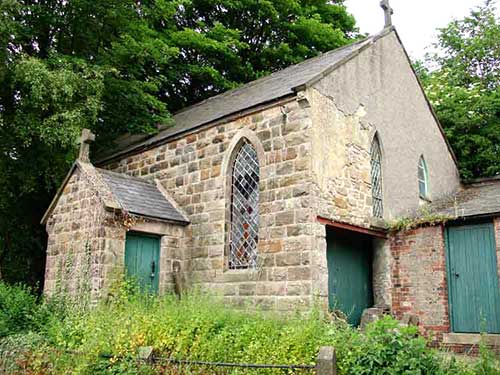
The now derelect Primitive Methodist Chapel on Hindersitch Lane
On Hindersitch Lane is a now derelict Primitive Methodist Chapel – on the left opposite Middle Lane. It was built c 1845 and held about 100 worshippers. A Sabbath School was taught here. It was built in 1847 to replace an earlier small tin-roofed chapel which was just above the junction of Hindersitch Lane and Top Lane.
Derbyshire Courier 22 July 1837
Crich Carr-on Sunday last the 16th instant, the Sunday School Sermons for the Primitive Methodist school, at Crich Carr, near Cromford, were preached in the open air (the chapel being far too small for the occasion) to very large audiences, by the Rev W Stokes, of Burton upon Trent. The collections exceeded those of former occasions, and testified the attachment of the people to the increasing schools of that picturesque village.
Derbyshire Advertiser and Journal 13 August 1847
Crich Carr – on Monday last, the children belonging to the Primitive Methodist Sunday school were regaled by their teachers and friends with tea and plumcake, in the newly erected chapel belonging to that society of Christians.
In 1878 this chapel was replaced with a new chapel on Top Lane.
Derbyshire Times and Chesterfield Herald 27 April 1878
Opening of a new chapel at Crich Carr near Belper
A new chapel in connection with the primitive Methodist body, was opened for Divine worship at Crich Carr, in the Belper circuit, last week. For nearly 40 years the primitive Methodists have conducted a public worship, and taught a Sabbath school, at Crich Carr, in the year 1845 they erected a small chapel, which will seat about 100 persons. This chapel has been made to serve for all purposes until the present time. It has however been long been inadequate for the accommodation of the congregation and the Sabbath school. It was therefore resolved some 18 months ago to make an effort to raise new and better premises. While deliberating on the matter, the society found a friend in Mr John Sims, of Crich Carr, who kindly offered to give an eligible site of land on which to erect a new chapel and schoolroom, the stone required, in the erection and £100 towards the cost thereof.
The Derbyshire Historic Environment Record
Building record MDR9798 - Former United Methodist Free Chapel, Hinderstitch Lane, Crich Carr, Crich.
Type and Period
United Methodist Free Chapel, (Georgian to Victorian - 1800 AD to 1882 AD)
Protected Status/Designation
World Heritage Site Buffer Zone
Full Description
There is a United Methodist Free Chapel situated here on the 1st edition OS map. The United Methodists have a chapel at Crich Carr . The building is still standing, but is no longer in use as a place of worship. The site looks quite overgrown and unoccupied at present.
Crich Carr Private School
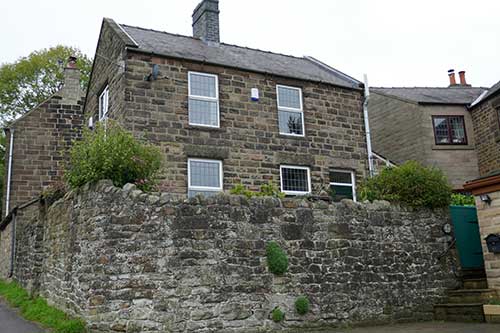
Allerton House, once Crich Carr private school
Just before the road leading to Glen Road, is Allerton House. This used to be a private school, attended by over 70 pupils, owned by the Misses Hurt of Chase Cliffe. It was referred to in a newspaper report of 1883.
çDerbyshire Times, 22 December 1883... The Parochial School and the British School at Crich had both been condemned by the Education Department, and a private school belonging to Misses Hurt, at Crich Carr had been condemned. A school had to be built at Crich Carr.
...accommodation must be found for seventy children at Crich and for seventy-five at Crich Carr
In 1884 is was reported that it was well attended (conducted by Miss Griffiths). This compared favourably with the five scholars attending the new Crich Carr C of E School.
Derbyshire Courier 29 March 1884
New arrangements had been made in connection with the private school at Crich Carr – conducted by Miss Griffith – which is well attended, and will be continued notwithstanding the additional school commendation now be provided. The plan for their new premises have been submitted by the British School Committee to the education department and have received general approval, and negotiations are proceeding respecting the proposed site.
Derbyshire Courier 30 August 1884
A correspondent informs me that the new school at Crich Carr, provided by the Parochial Committee, is commencing inauspiciously. The mistress, Mrs Hawke, of Derby, he says, will find her duties very light, as there were five scholars in attendance the first week, and an increase of two in the present week! Where will the money come from to keep the school going? The old school Crich Carr is still be carried on and the prospects of the new one are most unsatisfactory
Iron Grates ale house
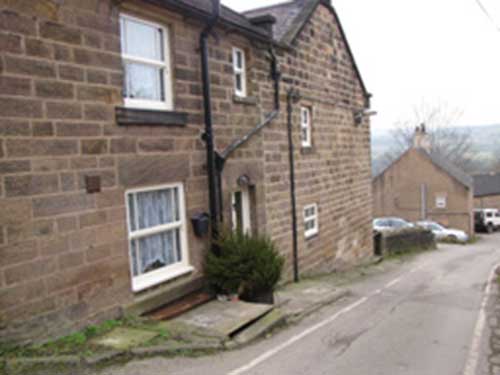
On Glen Road, was once an ale house known Iron Grates, now a private house. The photograph shows the iron grate covered by a wooden panel. This where the beer barrels were lowered in to the cellar.
In times past there were several ale/beer houses in the parish, many brewing their own ale for sale. Other similar Ale Houses were on Chadwicknick Lane, Plaistow Green, Wakebridge and on the Common, Crich.
The 1830 Beer Act allowed, for a two guineas (£2.10) fee, a licence to sell and serve beer in their own home. This became very popular and in the first year there were over 30,000 Beer Houses.
Footpath to St Mary's Church, Crich
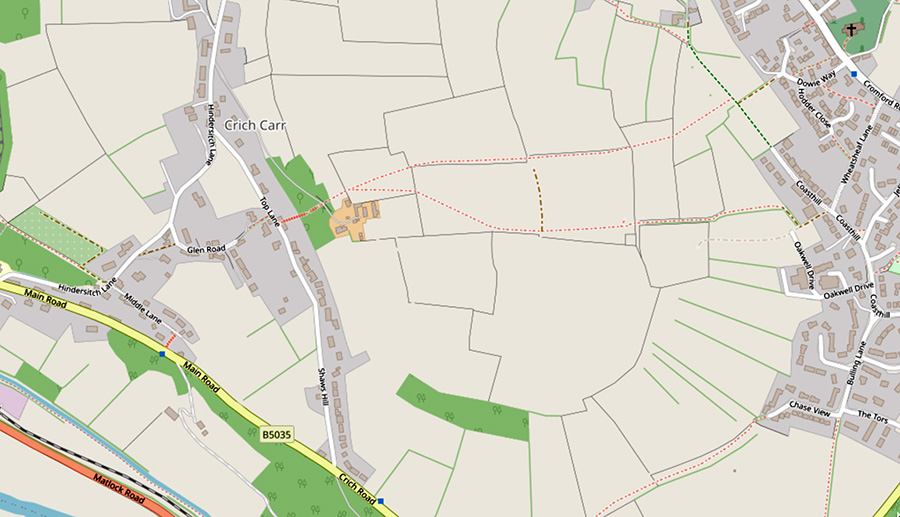
There was a direct footpath from Whatstandwell and Crich Carr to the parish church at Crich. It went along Glen Road, up the steps at the end, to cross Top Lane opposite the Tea Rooms and up Bryan's Steps which were alongside the Tea Rooms. A footpath across a field when it split in two directions, both these would eventually lead to the church as shown on the map.
Site of Market Garden and WW2 balloon making
Towards the top of Hindersith Lane on the left is a site that has an interesting history. After WW1 when Frederick Godfrey owned it he had green houses there and a market gardening operation. Also, he created a world famous hair treatment range of products (labelled Renuklor) which made him renowned. His adverts stretched from New Zealand to America. He made many scientific claims as to the efficiency of his products which were called into doubt in a widely reported American court case.

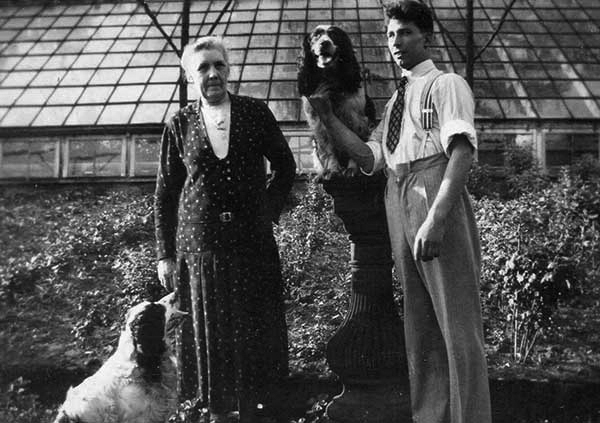
The Godrey family at their plant nursery on Hindersitch Lane
During WW2 the site buildings were used to make barrage balloons. Local ladies who were employed there found the off-cut silk material most useful.
The site is now that of a private house.
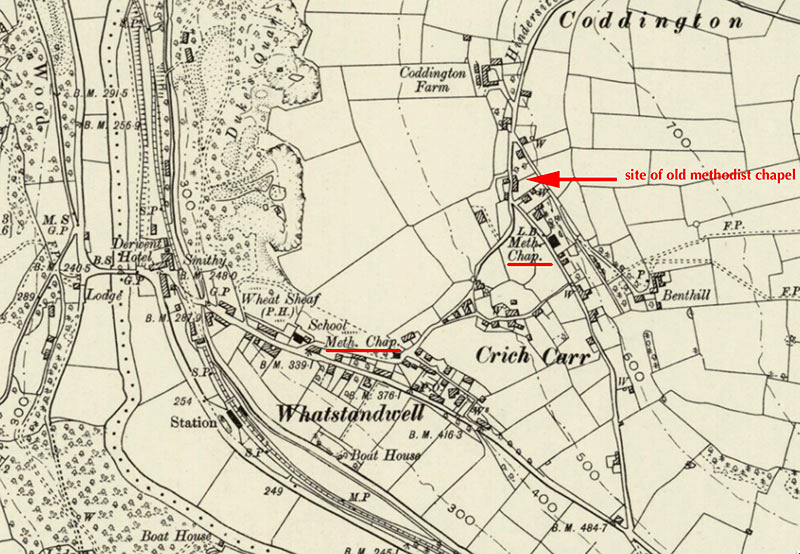
Site of the first Crich Carr Primitive Chapel
Just above the Top Lane Turn off is the site of the first Crich Carr Primitive Chapel, of which nothing remains
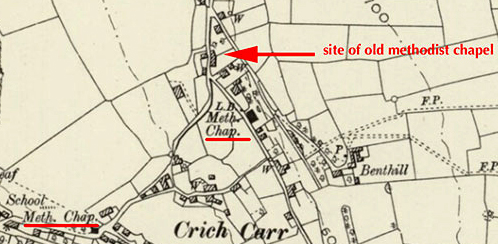
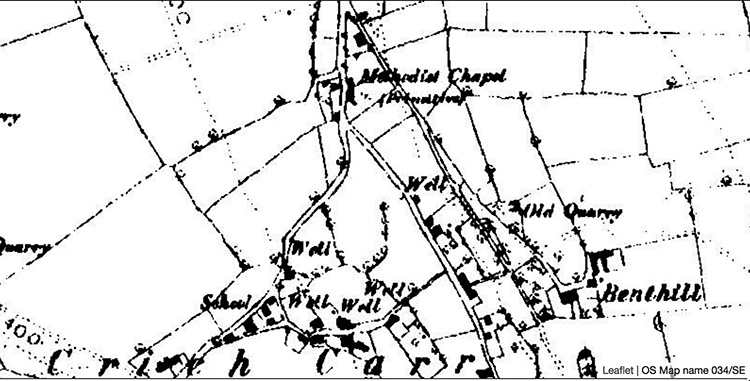
OS map 034/SE 1882–1896
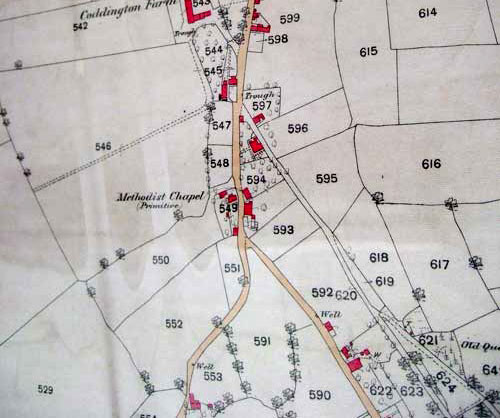
OS Map 1880
The OS map of 1880 records the old chapel buildings on the left of the road although oral history states it was a small barnlike building with a tin roof on the left of Hindersitch Lane as shown on the 1882 map.
Derbyshire Courier 22 July 1837
Crich Carr – on Sunday last the 16th instant, the Sunday School Sermons for the Primitive Methodist school, at Crich Carr, near Cromford, were preached in the open air (the chapel being far too small for the occasion) to very large audiences, by the Rev W Stokes, of Burton upon Trent. The collections exceeded those of former occasions, and testified the attachment of the people to the increasing schools of that picturesque village.
Burton's Windmill
In the same location as the First Primitive Methodist Chapel on the boundary between Crich Carr and Coddington stood Burton's Windmill.
Evidence of this windmill comes from "The Stone House Document Collection" by Mrs N. Billings. This private collection gives a most detailed history of The Stone House and its lands. The following information is reproduced by kind permission of Mrs N. Billing.
Document dated the 5th April 1842 stated that George Cowlishaw (farmer) sold for £100 to Joseph Anable (farmer) of Crich Carr plot No. 175 on the enclosure map – a plot of 4 acres 4 perches at Coddington Bank. This plot was part of the common and waste of Crich parish. This four acre plot has two small pieces of land sold from it: one of 1,100 yards, the other of 150 yards sold to John Burton and Daniel Spencer. [John Burton was grocer and baker of Crich.]
The Derbyshire and Chesterfield Reporter on 15th September 1842 reported that Mrs Mather, a neighbour of the windmill and of John Burton the miller, had only one child, a little lad of around eight. The windmill fascinated the little boy and he played close to the mill. On the previous Saturday he had taken shelter from heavy rain in the mill, but the miller shooed him away. The lad returned later and, innocently climbing up to the stage around the tower, the massive sail caught his head, wounding him fatally. Mr Hall, the Crich surgeon, used all his skill to save the child’s life but without hope.
A conveyance dated16th April 1844 between George Cowlishaw, Joseph Annable of Crich Carr, John Burton of Crich, grocer, Edward Carr late of Preston, druggist, but now of Belper stated that John Burton agreed to buy a further piece of land (150 square yards) from George Cowlishaw for £6, adjacent to John Burton’s other plot and beside John Burton’s windmill. Access to be along the existing seven foot wide trackway, to be widened to nine feet wide. Land to be occupied by Edward Carr for life.
In 1849 the windmill caught fire and was ruined.
Derby Mercury 21 Feb 1849
Total Destruction of a Corn Mill by Fire.
On Friday night, the 16th inst., the windmill belonging to Mr. John Burton, of Manchester, and lately in the occupation of Messrs. John and William Sykes, of Crich, situate at Crich Carr, in this county, was totally destroyed by fire. It appears the proprietor on that day had been drying the cylinders and other apparatus belonging to the mill which were in a damp state, and betwixt eight and nine o'clock at night he went, accompanied by a young man named John Holmes, to see that all was safe, and which apparently was so; but about eleven o'clock he was called out of bed to witness its total destruction, and so rapidly did the devouring element spread, owing to the combustible nature of the materials, that it was impossible to approach it, in order to make any attempt to stem its progress. About an hour after the fire was discovered the sails together with the large beams of timber came down with a tremendous crash, leaving the mill a complete wreck. Happily no person was injured. The drying kiln adjoining the mill escaped the fire, owing to its being situated to windward. How the fire originated is unknown. We are glad to hear Mr. B. was insured.
In a conveyance dated 18th October 1849 between John Burton late of Crich, grocer, but now of Manchester; Joseph Annable of Crich Carr, farmer; Joseph Stone of Wirksworth, gentleman (the solicitor) reference was made to a sale indenture of 12th June 1841 between George Cowlishaw and John Burton. Now, Joseph Annable has paid John Burton £30. At the time of the enclosure plot 175 was assigned to Thomas Carwood; these two pieces of land of 150 square yards are a part of it. A windmill built there following enclosure is now in ruins, but the stone and materials of the windmill are included in the sale.
From the field name map of 1849. "Poddington Allotment" should be "Coddington Allotment" and is Plot 175 on the enclosures map.
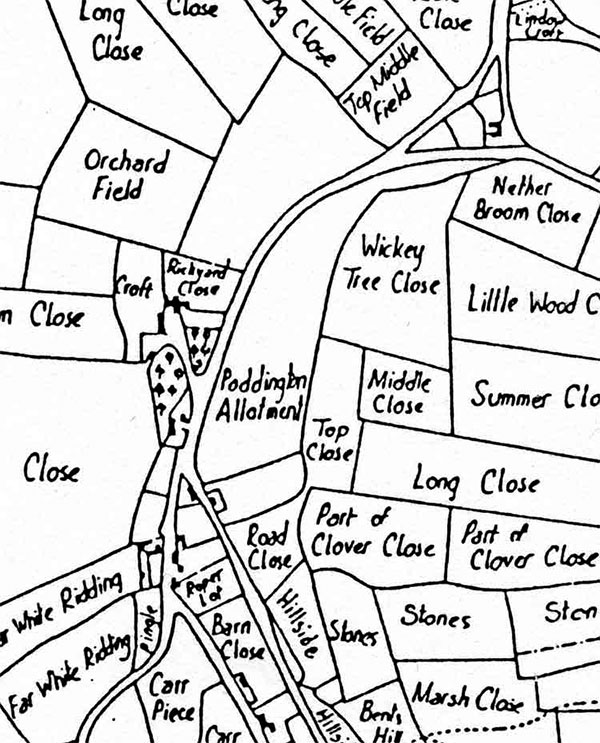
Conveyance of 25th March 1858 recorded that James Anable of Wirksworth, yeoman, to Walter Yates of Crich Carr, higgler, who has paid over now £340 including interest for the newly erected house on land described at enclosure as plot 175, but excluding the two fields of 150 square yards each. A windmill had been built here.
It is assumed that some of the stone from the ruined windmill was used to build Stone House. The 1880 maps shows the house building on plot 599
Coddington starts at about this position. Crich Carr continues down Top Lane.
Basket Maker
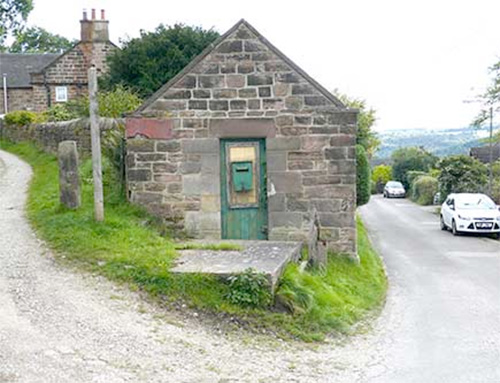
On Hindersitch Lane just before Top Lane, beside the farm track up to what was Bryan's farm on Bent Hill, is a building which was once a basket maker's workshop. Basket makers were also called whisket makers.
The 1831 Crich census recorded that there were four basket makers in the parish. Whether these were all of one family or separate individuals is unknown. What is known from census records and church records is that John Wragg and his family were basket makers at Crich Carr in the 1830s and 1840s.