Will of Edward Fidler 1721
VIEW the will of Edward Fidler of Wakebridge
Indentures at Crich
17 Mar 1773: Martha CHEETHAM a poor child of the parish apprentice to John SAXTON, Wakebridge Hall
Land tax 1790
Proprieter:Peter Nightingale Esq – Occupier: William Goodale (Wakebridge) – Assessment £8 1s 4d
A Description of Crich and South Wingfield
A Transcription of the 18th Century Manuscripts of John Reynolds
Transcribed by Stuart Hill and reproduced with his permission.
This Parish contains therein these Villages or Hamlets following viz. Crich, Frichley, Plaistow and Wheatcroft, together with two Farms, which have antient and distinct names, the one called Wakebridge, and the other the Edge, all which lie within the Hundred of Moreleston & Litchurch, and Washington or Wessington which lies in the Hundred of Scarsdale, and Tansley within the Wapentake or Hund'd of Wirksworth.
Wakebridge, antiently written Wakebrugge, and Wakebrugg and since that time Wakbrige and Watebrige, seems once to have been a Lordship, because one of the Poole's some time owner thereof, is Stiled upon his Tomb in Crich Church Dominus de Watebrige. But now the Hall or mansion House and the greatest pt. of the Farm, is reckoned to be in the Mannor of Lea, and the remainder (being but small) within the Mannor of Crich. The whole however is within the Hundred of Morleston.
[Marginal Note: He died Ao 1588]
The Antient Owners thereof, were surnamed from the place. De Wakebrugge, from whom it passed by marriage to ye Poole's (one of which served the Office of Sheriff of Derbyshire and Nottinghamshire in 14.7) who continued owners thereof till about the yr 1751. when Mrs. Mary Poole, relict of John Poole of Spinkhill, Gent. dying, it descended to Garrat Morphy of Abbelaix in Queens County in the Kingdom of Ireland, Gent, Eldest Son of Revel Morphy by the only Sister of the said John Poole, who now owns the same.
[Marginal Note: vizt. in 1760.]
Above is an extract from this article. VIEW the complete article.
Parish Boundary stone at Wakebridge farm
Photo: Peter Patilla
Information: Ken Hawley
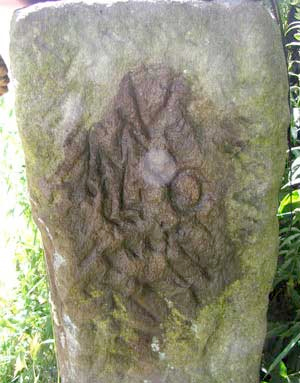
Parish boundary marker near Wakebridge Farm
N53º05.931'
W001º29.949'
Elevation 740 ft
John Claye of Wakebridge
John Claye (whose grandfather John came from Chapel-en-le Frith and had also lived in Crich) built a Manor house next to the Northwest corner of the churchyard. In 1597, John Claye (then said to be ' of Wakebridge') was one of the gentleman of Derbyshire who was 'requested' to make a 'loan' to the Crown. These loans were requested from Counties by the Privy Council acting on behalf of Elizabeth. The Earl of Shrewsbury delegated the job of collecting the money from Derbyshire to John Manners and on an earlier occasion in 1589 he had written to John Manners (his brother-in-law) to say that he was "troubled to hear of slackness of those gentleman who ought to be most favoured to do the Queen's pleasure" - and he recommended that new 'privy seals' be delivered to those in arrear and warning them of the need to make payment by an early date. The 'privy seal' was the official document demanding the particular share of the 'loan' assigned to a particular person, sealed with the royal privy-seal, and sent down to their local agent in the provinces by the Council. John Manners was beset with requests from many of those to whom privy-seals had been addressed - one such being John Claye. Later that year (1589) the Earl of Shrewsbury was informed from the Court that "sums of £50 imposed under a Privy Seal on John Claye of Crich be reduced to £25 - as they have large families and are in debt". Building the Manor House and buying the tithes from Anthony Babington must have upset Clayes 'cash-flow'.
The examination of John Dakin, 8th January [1605/06], touching certain slanderous speeches used by John Clay of Crich, gentleman, accusing the Earl of Shrewsbury of being forewarned of the Gunpowder Plot and of absenting himself from Parliament 'under colour of his happy gout'; of having created Sir John Harpur, a man devoted to him, a deputy lieutenant of the county just before; and of conniving at the absence from Parliament of Sir John Harpur, a knight of the shire, and from London of Sir Charles Cavendish, annotated by the seventh Earl. Address in seventh Earl's hand
Speeches spoken by Mr John Clay of Crich in the county of Derbye
gent upon the eighth daie of January beinge Wednesday at
his house in Crich aforesaid to me John Dakin in the presence
of Thomas Williamson of Wakebridge & others.
From "A Tale of Crich" Chapter 2 by Dr Geoffrey Dawes